


Beyond Problem-solving: What Happens In A Balint Group
Some clients stay with us long after a session has ended.
Perhaps you find yourself thinking about them unexpectedly during the day. You may feel unusually anxious, irritated, helpless, protective, hopeful, confused, or preoccupied. Sometimes there is no obvious crisis and no clear explanation for why a particular client or therapeutic relationship has such a hold on the mind.
For psychotherapists and other clinicians, these are often the cases that most need thought. Yet they may not need more advice, another formulation, or an immediate plan of action. They may require a different kind of attention: a reflective space in which the emotional and relational life of the work can be explored.
That is the purpose of a Balint group.
What is a Balint group?
A Balint group is a structured, confidential, and non-evaluative form of reflective practice for clinicians. It focuses on the relationship between practitioner and client or patient: what is happening emotionally, consciously and unconsciously, in the encounter between them.
A practitioner brings a brief account of a client relationship that has become troubling, puzzling, moving, stuck, or particularly alive. The account does not need to be a full case history or concern a dramatic event. It may centre on a moment in a session, an uncomfortable feeling, an ending, a recurring impasse, or a sense that something important is happening but cannot yet be put into words.
Rather than seeking diagnosis, treatment advice, risk-management guidance, or expert solutions, the group reflects on what the story evokes. Through this shared reflection, the presenter may begin to see the clinical relationship differently.
Balint groups are especially valuable for practitioners who work in emotionally demanding settings and who want to develop a deeper capacity to think about their own responses in clinical work.
From Budapest to the Tavistock
Balint groups take their name from Michael Balint (1896–1970), the Hungarian-born physician, biochemist, and psychoanalyst whose work transformed how many clinicians think about the practitioner–patient relationship.
Balint’s intellectual and clinical development was strongly influenced by the Hungarian psychoanalyst Sándor Ferenczi with whom he studied and later undertook analysis. Ferenczi was an important early influence on relational psychoanalysis because he challenged the ideal of the detached, impersonal analyst. He placed greater emphasis on emotional responsiveness, the therapeutic relationship, and the analyst’s subjective experience.
This attention to what happens between two people, rather than simply within one person, became foundational to Balint’s later work and the relational movement more broadly.
After emigrating to England, Balint began leading seminars for general practitioners at London’s Tavistock Clinic from 1948. At the time, this was a radical approach. Doctors were not invited to present cases in order to obtain diagnostic answers, treatment plans, or expert advice. Instead, they were encouraged to consider the emotional and relational dimensions of their encounters with patients.
Balint famously suggested that the most commonly prescribed “drug” in general practice was the doctor themselves. In other words, the person of the clinician - and the relationship they form with the patient – is likely to have a profound influence on treatment. Yet this influence was often insufficiently examined.
Balint’s influential book, The Doctor, His Patient and the Illness (1957), emerged from this work and remains relevant to psychotherapists and other clinicians today.
Enid Balint, Michael Balint’s wife, was also essential to the development of the method. A social worker, psychoanalyst, and relational thinker, she helped shape the model, led the GP Training and Research Course at the Tavistock, and continued to support, grow and develop the Balint method internationally after Michael Balint’s death.
What happens in a Balint group?
A Balint group usually begins with one practitioner presenting a short account of a clinical encounter or situation with a client. The presenter may describe a client who remains on their mind, an interaction that felt unsettling, or a case in which they feel unusually stuck.
The group may ask a small number of factual questions to understand the basic circumstances. These questions are not intended to gather a comprehensive history or establish a diagnosis. They simply provide enough context for the group to enter the story.
The presenter then steps back from the active discussion and listens while the group reflects on the material. In traditional Balint language, the presenter “hands the case to the group.” They remain present, but they are invited to listen rather than explain, defend, correct, or answer questions.
Group members are encouraged to share what the case evokes in them. This may include:
- Feelings, emotional responses, and bodily sensations
- Images, metaphors, memories, or associations
- Thoughts about the client, practitioner, or relationship
- Questions and uncertainties
- Different and even contradictory impressions.
The group’s task is not to decide what the case means. Nor is it to determine what the practitioner should do next. Instead, it seeks to stay close to the emotional and relational field created by the story.
This process is sometimes described as collective free association. Members speak from their own experience, using tentative and personal language: “I found myself feeling anxious as I listened,” or “I imagined the client as feeling very alone.” The emphasis is on curiosity rather than certainty.
A trained Balint leader helps preserve this distinctive frame. They discourage the group from moving too quickly into diagnosis, interpretation, advice-giving, theoretical debate, or treatment recommendations. This protects the presenter from being judged or instructed and allows the group’s speculative thinking to remain alive.
At the end of the discussion, the presenter is invited to respond. They may describe what felt useful, surprising, resonant, or difficult. The aim is not necessarily for the group to have produced an answer. Often, the value lies in the presenter leaving with a wider and more imaginative sense of what may be happening in the relationship.

This process is sometimes described as collective free association. Members speak from their own experience, using tentative and personal language. The emphasis is on curiosity rather than certainty.
Not therapy or usual supervision
A Balint group is not a form of group therapy.
Participants may feel moved by the material, and their own experiences may be stirred by what they hear. However, the focus remains on the practitioner–client relationship rather than on participants’ personal histories or psychological difficulties. Members are not expected to disclose personal material or work through their own concerns in the group.
Nor is a Balint group primarily a group-process forum. Although the group’s emotional atmosphere may occasionally provide useful information, the central task is to think about the clinical relationship brought by the presenter, not to make the interpersonal dynamics of the group itself the main subject.
Balint groups also differ from conventional clinical supervision.
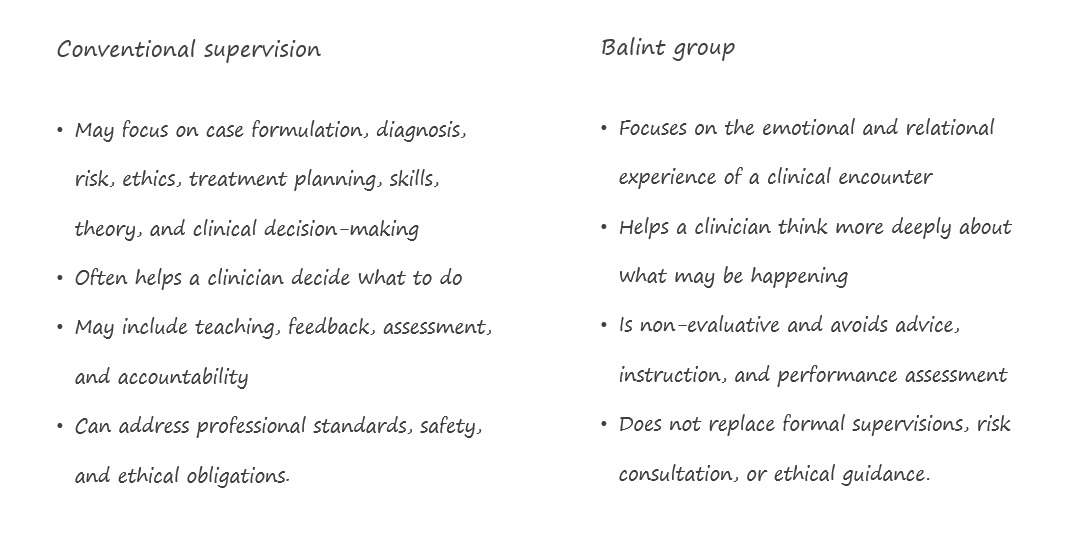
These distinctions matter. Clinicians need access to high-quality supervision that can address risk, ethical dilemmas, professional responsibilities, and treatment decisions. A Balint group is best understood as a complementary practice rather than a substitute for individual or formal clinical supervision.
Its particular contribution is to create space for uncertainty. It supports the practitioner to remain thoughtful when they feel pulled towards certainty, self-criticism, rescue, withdrawal, frustration, or premature action.
Why Balint groups matter
Clinical work asks practitioners to use themselves as part of the therapeutic process. Our emotional responses, expectations, fears, hopes, and assumptions can all shape what happens in the room. Yet the pace and pressure of professional life can make it difficult to pause long enough to think about these experiences.
Balint groups offer a disciplined way of doing so.
Participation may help clinicians to:
- Develop greater awareness of their own emotional responses in clinical work
- Deepen empathy for clients, particularly in difficult or stalled relationships
- Tolerate uncertainty without rushing towards explanation or action
- Notice relational patterns that might otherwise remain outside awareness
- Feel less isolated with demanding, confusing, or emotionally charged cases
- Strengthen a reflective professional identity and clinical imagination.
The value of a Balint group does not lie in finding the correct interpretation. Its value lies in expanding the possibilities available to thought.
A case that initially feels frustrating or opaque may begin to look different when a group brings many minds, associations, and emotional responses to it. The presenter may recognise something about the client’s experience, their own involvement in the relationship, or the unconscious communication occurring within the therapeutic field.
This can be quietly transformative. Not because the group has solved the case, but because the practitioner is no longer alone with it.
A reflective practice for clinicians
Whether conducted in person or online, a Balint group provides a distinctive professional space: confidential, collaborative, non-judgemental, and focused on the relationships that make clinical work possible.
For psychotherapists, counsellors, psychologists, doctors, social workers, and other helping professionals, Balint work can be a valuable complement to individual supervision. It offers a way to become more reflective, imaginative, and emotionally available in the face of the complex relationships at the heart of practice.
If you are interested in joining an online Balint group, contact Brad McLean.
Article written by Brad McLean, Clinical Psychotherapist & Relationship Therapist